39 aws rekognition detect custom labels
Amazon Rekognition Custom Labelsでカスタムモデルを ... - Qiita アップロードしたデータセットを元に、Amazon Rekognition Custom Labelsをトレーニングし、 画像ファイルに含まれるナンバープレートを検知するためのモデルを構築します。 また、構築したモデルを使ってAWS CLIでテストをしてみます。 2. Amazon Rekognition Custom Labels ... r/aws - Real-world usage of Rekognition w/ Custom Labels Rekognition custom labels is meant to be used continuously, and maximize the inference hour by requests, not for a few standalone request here-and-there. You should measure how many inference calls you can make per hour per inference unit (depends on your model), and divide the hourly cost by this number. That is your cost / inference.
detect-custom-labels — AWS CLI 1.22.60 Command Reference detect-custom-labels ¶ Description ¶ Detects custom labels in a supplied image by using an Amazon Rekognition Custom Labels model. You specify which version of a model version to use by using the ProjectVersionArn input parameter. You pass the input image as base64-encoded image bytes or as a reference to an image in an Amazon S3 bucket.

Aws rekognition detect custom labels
Training a custom single class object detection model with Amazon ... On the Amazon Rekognition console, choose Custom Labels. Choose Get Started. For Project name, enter PizzaDetection. Choose Create project You can also create a project on the Projects page. You can access the Projects page via the left navigation pane. Creating your dataset Rekognition — Boto3 Docs 1.24.28 documentation - Amazon Web Services Creates a new Amazon Rekognition Custom Labels project. A project is a group of resources (datasets, model versions) that you use to create and manage Amazon Rekognition Custom Labels models. This operation requires permissions to perform the rekognition:CreateProject action. See also: AWS API Documentation. Request Syntax detect-custom-labels missing from AWS CLI (Windows) I am following instructions both here - and on the AWS Console itself in order to test recognition against a model / dataset I have built using custom labels.
Aws rekognition detect custom labels. GitHub - aws-samples/serverless-rekognition-custom-labels The process of training the model is described step by step in the blog post with the use of the notebooks. 1 - Access the AWS CloudFormation console and deploy the template.yaml as a new stack. 2 - Run noteboos/1_prepare_data.ipynb to download and preprocess the data into the S3 bucket. 3 - Use Amazon Rekognition Custom Labels to train an ... Using Amazon Rekognition Custom Labels and Amazon A2I ... - aws.amazon.com For instructions on creating a project, see Creating an Amazon Rekognition Custom Labels Project. On the Amazon Rekognition console, choose Custom Labels. Choose Get started. For Project name, enter a2i-rekog-pepperoni-pizza. Choose Create project. Creating a dataset To create your dataset, complete the following steps: Machine learning: analyzing images with Amazon Rekognition Custom Labels Amazon Rekognition Custom Labels; AWS IAM Via the AWS Management Console you find the IAM service in section Security, Identity, & Compliance. You need to create a group and a user in that group with sufficient rights. ... aws rekognition detect-custom-labels \ -project-version-arn "arn:aws:rekognition:eu-west-1:938506314627:project ... Batch image processing with Amazon Rekognition Custom Labels | AWS ... Amazon Rekognition Custom Labels provides a simple end-to-end experience where you start by labeling a dataset, and Amazon Rekognition Custom Labels builds a custom ML model for you by inspecting the data and selecting the right ML algorithm. After your model is trained, you can start using it immediately for image analysis.
Rekognition Custom Labels Max Results | AWS re:Post That means, you can train a model that can classify/detect 250 unique labels. Maximum number of labels per image is 50. That means, you can add maximum 50 labels/bounding boxes to your each image. Please refer this public documentation for more details. AWS-Pavan rekognition — AWS CLI 2.7.15 Command Reference Description¶. This is the API Reference for Amazon Rekognition Image, Amazon Rekognition Custom Labels, Amazon Rekognition Stored Video, Amazon Rekognition Streaming Video.It provides descriptions of actions, data types, common parameters, and common errors. Amazon Rekognition Custom Labels Community Showcase Amazon Rekognition Custom Labels allows you to detect custom labeled objects and scenes with zero Jupyter notebook experience. For example, you can identify logos in streaming media, simplify preventative maintenance, and scale supply chain inventory management. amazon-rekognition-custom-ppe-detection-with-custom-labels ... - GitHub Training Workflow Call Flow. Web application uploads image(s) to source S3 bucket. (_Note: Amazon S3 Transfer Accelection is used to reduce the upload time by taking advantage of the global Amazon CloudFront edge locations) Send a POST /analyze request, specified labelOnly=true query parameter to indicate using Rekognition.DetectLabels API only
Detecting labels in an image - Amazon Rekognition You can use the DetectLabels operation to detect labels in an image. For an example, see Analyzing images stored in an Amazon S3 bucket. The following examples use various AWS SDKs and the AWS CLI to call DetectLabels. For information about the DetectLabels operation response, see DetectLabels response. To detect labels in an image Amazon now lets customers label and track specific objects with Rekognition Amazon Web Services (AWS) today announced that Rekognition, its cloud-based software-as-a-service computer vision platform, will soon gain custom labels that'll allow customers to craft object ... detect-custom-labels — AWS CLI 2.1.29 Command Reference detect-custom-labels ¶ Description ¶ Detects custom labels in a supplied image by using an Amazon Rekognition Custom Labels model. You specify which version of a model version to use by using the ProjectVersionArn input parameter. You pass the input image as base64-encoded image bytes or as a reference to an image in an Amazon S3 bucket. Using Amazon Rekognition Custom Labels from R to train a Swoosh ... R users can access and use Amazon Rekognition Custom Labels using the fabulous paws package, an AWS SDK for R, created by David Kretch and Adam Banker. In this article, we will use Rekognition Custom Labels to train an object detection model to detect the Swoosh, Nike's famous logo that Carolyn Davidson designed in 1971:
Use computer vision to detect crop disease through image analysis with Amazon Rekognition Custom ...
What Is Amazon Rekognition Custom Labels? The Amazon Rekognition Custom Labels console provides a visual interface to make labeling your images fast and simple. The interface allows you to apply a label to the entire image. You can also identify and label specific objects in images using bounding boxes with a click-and-drag interface.

Announcing Amazon Rekognition Custom Labels | AWS Machine Learning Blog
Amazon Rekognition Custom Labels Behind the scenes, Rekognition Custom Labels automatically loads and inspects the training data, selects the right machine learning algorithms, trains a model, and provides model performance metrics. You can then use your custom model via the Rekognition Custom Labels API and integrate it into your applications. Use cases

Use computer vision to detect crop disease through image analysis with Amazon Rekognition Custom ...
How to Detect Objects Using Python and AWS Rekognition Detecting a label. For AWS Rekognition, a label (or a tag) is everything that it can identify inside an image or a video, like objects (person, tree), scene (beach) or concept (outdoor). If you are using a video, it can also detect an activity (like swimming). To detect all the labels inside an image, we first need to get the Rekognition client.

Announcing Amazon Rekognition Custom Labels | AWS Machine Learning Blog
Getting started with Amazon Rekognition Custom Labels Sign in to the AWS Management Console and open the Amazon Rekognition console at . In the left pane, choose Use Custom Labels. The Amazon Rekognition Custom Labels landing page is shown. If you don't see Use Custom Labels, check that the AWS Region you are using supports Amazon Rekognition Custom Labels.

Using Amazon Rekognition Custom Labels from R to train a Swoosh detector · alex23lemm
DetectCustomLabels - Amazon Rekognition Amazon Rekognition Custom Labels expresses an assumed threshold as a floating point value between 0-1. The range of MinConfidence normalizes the assumed threshold to a percentage value (0-100). Confidence responses from DetectCustomLabels are also returned as a percentage. You can use MinConfidence to change the precision and recall or your model.
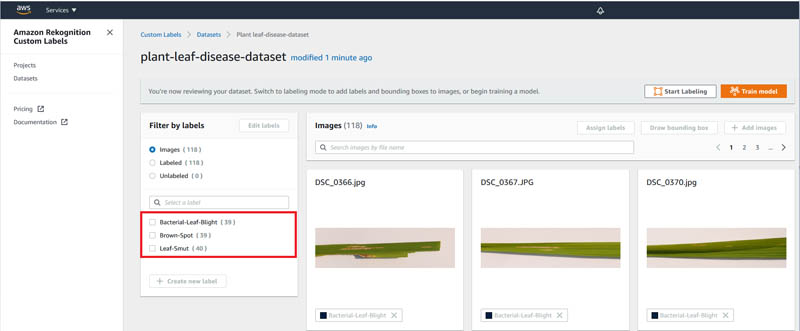
Use computer vision to detect crop disease through image analysis with Amazon Rekognition Custom ...
detect-custom-labels — AWS CLI 2.7.12 Command Reference rekognition] detect-custom-labels¶ Description¶ Detects custom labels in a supplied image by using an Amazon Rekognition Custom Labels model. You specify which version of a model version to use by using the ProjectVersionArninput parameter. You pass the input image as base64-encoded image bytes or as a reference to an image in an Amazon S3 bucket.

Labels :: OpenShift 4 on AWS
detect-custom-labels missing from AWS CLI (Windows) I am following instructions both here - and on the AWS Console itself in order to test recognition against a model / dataset I have built using custom labels.
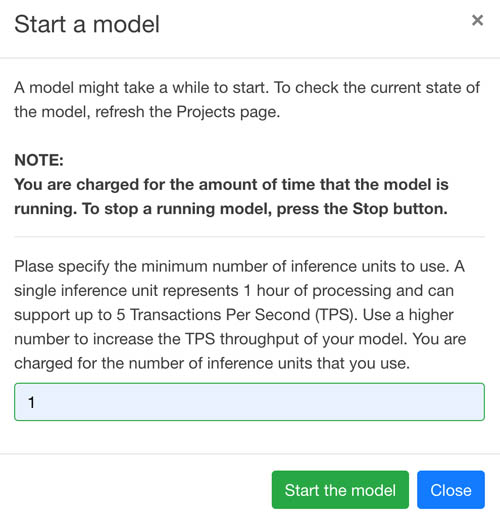
Automate weed detection in farm crops using Amazon Rekognition Custom Labels | AWS Machine ...
Rekognition — Boto3 Docs 1.24.28 documentation - Amazon Web Services Creates a new Amazon Rekognition Custom Labels project. A project is a group of resources (datasets, model versions) that you use to create and manage Amazon Rekognition Custom Labels models. This operation requires permissions to perform the rekognition:CreateProject action. See also: AWS API Documentation. Request Syntax

Exploring ML Tools — Amazon Rekognition | by Nikhil Jabade | Explore ML | Medium
Training a custom single class object detection model with Amazon ... On the Amazon Rekognition console, choose Custom Labels. Choose Get Started. For Project name, enter PizzaDetection. Choose Create project You can also create a project on the Projects page. You can access the Projects page via the left navigation pane. Creating your dataset

Custom Object Detection in der Cloud am Beispiel von Amazon AWS Custom Label Recognition ...

Solved: AWS resource-id tag is not available - Community | AppDynamics

AI & AWS DeepComposer
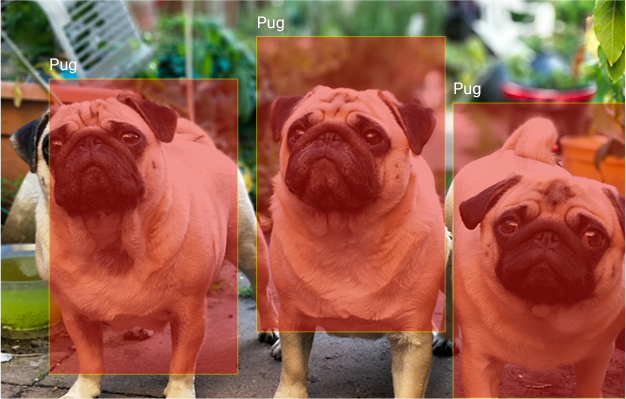
AWS Rekognition Integration Company | Winterwind

AWS Code Services
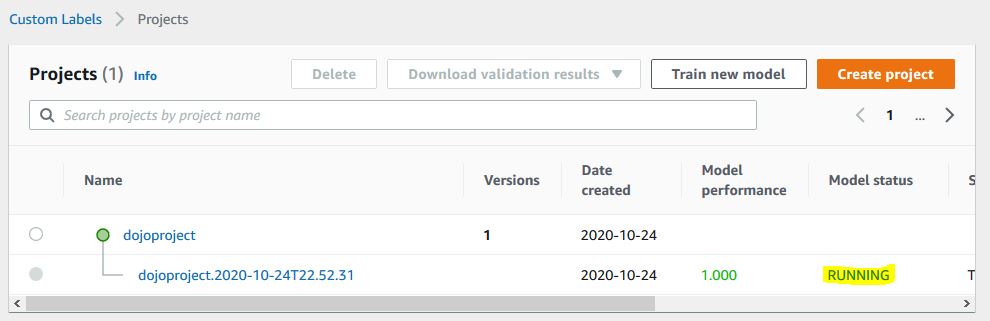
AWS Dojo - Workshop - Create Custom Models using Amazon Rekognition Custom Labels
What Is 'AWS CodeArtifact'? - DZone DevOps
Post a Comment for "39 aws rekognition detect custom labels"